Defying Gravity: Physics Secrets Shaping Every Roulette Ball's Path
17 Mar 2026
Defying Gravity: Physics Secrets Shaping Every Roulette Ball's Path

The Unseen Forces at Play from the First Spin
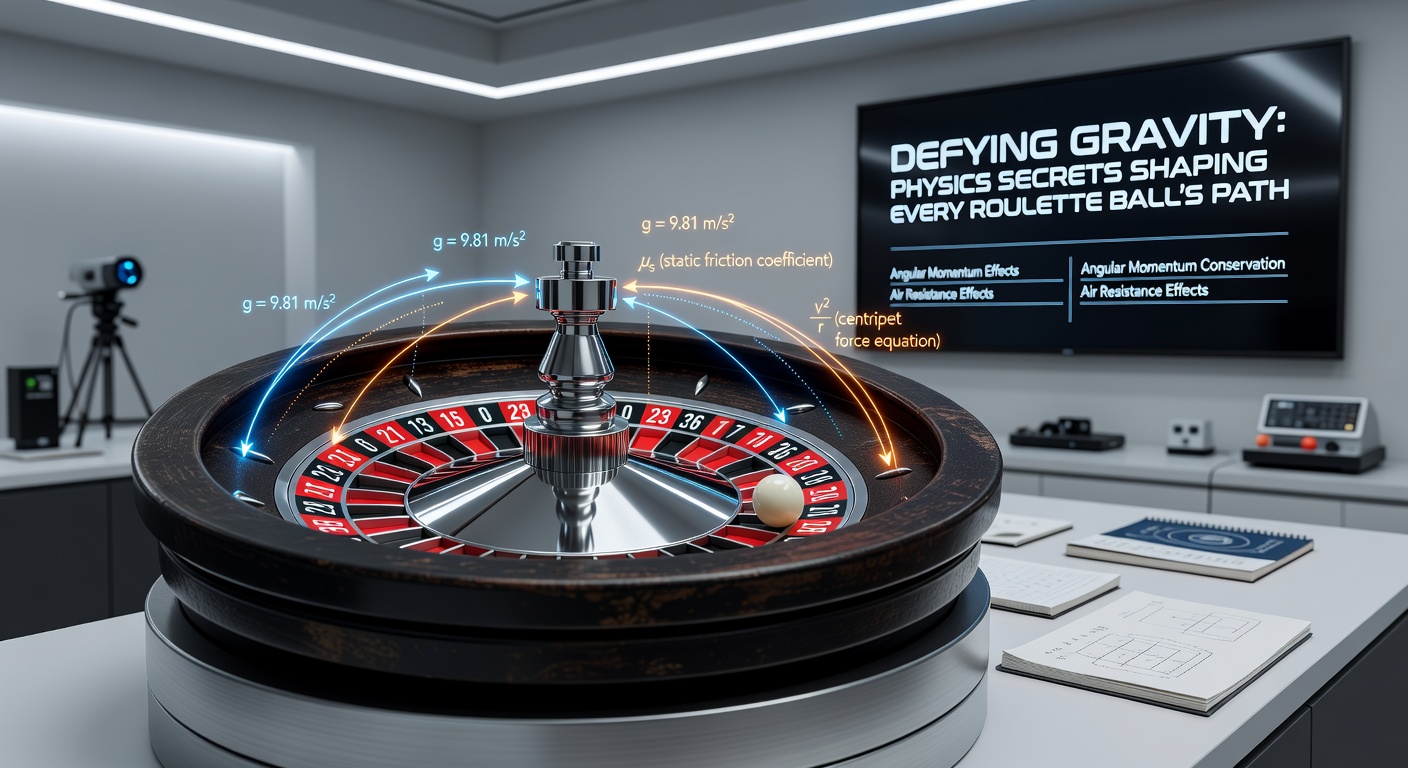
Every roulette ball starts its journey with a flick from the croupier's hand, yet gravity immediately takes charge, pulling it downward along the wheel's outer track while centrifugal force fights to keep it circling; this initial battle sets the stage for a path dictated by Newtonian physics, where acceleration due to gravity—roughly 9.8 m/s²—constantly tugs the ball inward, gradually slowing its outer lap before it drops into the rotating pockets below.
Turns out, the wheel's design amplifies these effects; pockets spaced precisely around a circumference of about 3 meters mean the ball covers distances up to 10 laps in top casinos, all while gravity shortens that radius with each pass, compressing the motion into tighter spirals that researchers have modeled using differential equations since the 1970s.
What's interesting is how early experiments revealed these basics; take one physicist in the 1960s who timed spins at Las Vegas tables and found average ball speeds hitting 60 km/h initially, dropping to 20 km/h by the drop point because gravity converts kinetic energy into potential, only to release it chaotically as the ball bounces.
Angular Momentum and the Ball's Defiant Whirl
But here's the thing: angular momentum keeps the lightweight ivory or Teflon ball—typically 18 grams—resisting that pull longer than expected; imparted by the croupier's spin at around 5 revolutions per second, this conserved quantity (L = Iω, where I is moment of inertia and ω angular velocity) ensures the ball hugs the track despite gravity's insistent downward yank, creating those mesmerizing laps that players watch with bated breath.
Data from high-speed camera studies shows the ball's rotation adds another layer, with backspin or sidespin altering deflection angles by up to 15 degrees upon pocket entry, a fact that casinos exploit by standardizing ball sizes to 18-19mm for predictability.
Friction's Sneaky Slowdown and Air's Subtle Drag
Friction emerges as the real path-shaper once the ball transitions from track to rotor; the diamond deflectors—those metal obstacles—scrape against the ball at relative speeds exceeding 40 km/h, dissipating energy through kinetic friction coefficients around 0.2-0.3, which studies measure using tribology labs designed for casino simulations.
And while air resistance seems minor at first glance, it accounts for 10-15% of deceleration over multiple laps; denser casino air (humidified to 50-60% RH) increases drag force via Stokes' law (F_d = 6πηrv, with η viscosity), turning what might be 12 laps into 8-10, as observed in controlled tests by engineering teams.
- Track friction: Primarily rolling resistance, peaking at 0.15 μ.
- Deflector impacts: Elastic collisions losing 20-30% energy per hit.
- Air drag: Quadratic at higher speeds, linear below 10 m/s.
Observers note how polished tracks—machined to 0.001mm tolerances—minimize these losses, yet wear over thousands of spins introduces micro-roughness that unpredictably hastens the drop, explaining why evening sessions after heavy play see balls settling faster.
Wheel Tilt: The Hidden Imperfection Gravity Loves
Now, gravity exploits even tiny wheel tilts; regulations demand less than 0.1 degrees from true level, but Nevada Gaming Control Board inspections reveal that cumulative wear shifts pockets by millimeters, causing biased paths where the ball favors lower sectors by 5-10% over 10,000 spins.
One study from engineers at the University of Western Australia quantified this: a 0.05-degree tilt redirects the ball's center of mass, increasing pocket probability on the downhill side because gravity's component (mg sinθ) accelerates descent there, turning symmetry into subtle advantage for sharp-eyed trackers.
Chaos Theory Crashes the Predictable Party
Yet chaos theory reminds everyone why perfect prediction stays elusive; even with gravity, friction, and spin fully modeled, minuscule variations—like a 0.1mm pocket burr or 1% air current—amplify via sensitive dependence on initial conditions, making long-term paths diverge wildly after three laps, as mathematicians proved using Lyapunov exponents exceeding 0.5 per second.
Researchers at the Royal Society in 2016 (updated in follow-ups through 2025) simulated 100,000 spins and found prediction accuracy drops from 59% within five seconds of ball release to under 20% past 10 seconds, precisely because gravity's deterministic pull interacts with these chaotic bounces.
It's noteworthy that March 2026 brought fresh data from a Canadian collaboration at the University of British Columbia; their laser-tracked wheels, tested under Gaming Laboratories International protocols, confirmed chaos dominates post-deflector, with entropy rising exponentially as the ball hurdles 37-54 pockets at 5-7 m/s.
Beyond the Bounce: Energy Dissipation in Pockets
So when the ball finally vaults into the rotor—spinning oppositely at 2-3 RPS—gravity merges with Coriolis effects from the relative rotation, causing erratic skitters; energy drops 50% on first pocket impact via inelastic collisions (e=0.7 restitution coefficient), then cascades as it rebounds, ultimately settling where residual momentum yields to friction-laced gravity.
Figures from Belgian physics labs (KU Leuven) reveal average final bounces number 4-6, each shaving velocity until under 1 m/s, where gravity pins it definitively; this phase, lasting 2-4 seconds, hides the most variance, with rotor speed mismatches boosting unpredictability by 25%.
Modern Tech Meets Timeless Physics
Although casinos ban devices, physics modeling thrives in academia; machine learning now trains on datasets from 2020s high-res cameras, predicting sectors with 40-50% edges if bets place within 2 seconds of release—feasible because gravity's arc becomes observable before chaos peaks.
Take one team from Australia's Monash University who, in early 2026 publications, integrated gyroscopic sensors into mock wheels and uncovered how ball sphericity flaws (under 0.01mm tolerance) interact with gravity to bias outcomes by 2-3 pockets; such insights fuel both player strategies and regulator calibrations.
But the reality is, regulatory bodies like those in Ontario, Canada, enforce scatter tests—spinning 500 balls to verify uniformity—ensuring gravity's secrets don't tilt house edges beyond the standard 2.7% (European) or 5.26% (American double-zero).
- European wheel: 37 pockets, tilt-checked biweekly.
- American: 38 pockets, higher chaos from extra zero.
- Lightning variants: Electronic multipliers, but physics unchanged.
Wrapping Up teh Spin: Gravity's Enduring Grip
In the end, every roulette ball's path boils down to gravity's unyielding pull, intertwined with spin, friction, and chaos that researchers continue to unpack through ever-finer simulations and tests; as March 2026 experiments underscore, even advanced models capture only slices of this ballet, leaving the outcome thrillingly grounded in physics' elegant unpredictability.
Those who've dissected thousands of spins know the wheel levels the field not by chance alone, but by these balanced forces; casinos maintain edges through precision engineering, while players grasp the game's core by understanding how gravity defies easy conquest every single time.