7 Aug 2026
Legends of the Wheel: How Iconic Figures Reshaped Roulette Variants Through Personal Tactics and Cultural Shifts

Blaise Pascal developed the foundational wheel mechanism during the 17th century while pursuing perpetual motion devices, and that invention later combined with French gaming traditions to produce the game known today as roulette; observers note how this single engineering effort set the stage for multiple regional adaptations over the following centuries.
Francois Blanc and his brother Louis established the single-zero wheel in the mid-1800s at the Bad Homburg casino, a modification that reduced the house edge compared with earlier double-zero formats and attracted players across Europe; records from that period show the Blancs also introduced the "en prison" rule, which allowed even-money bets to remain active after a zero outcome and thereby altered standard payout structures in what became known as French roulette.
American Expansion and the Double-Zero Addition
During the California Gold Rush and subsequent westward migration, casino operators in the United States added a second green zero to the wheel, creating the American variant that offered a higher house advantage; historians document how this change reflected local economic pressures and the desire for faster revenue cycles in frontier gambling houses, while the layout of the betting table stayed largely consistent with European predecessors.
Joseph Jagger, a British engineer, applied mechanical observation techniques at the Monte Carlo casino in 1873 by recording wheel outcomes over multiple days and identified biases caused by manufacturing imperfections; his team placed coordinated bets that reportedly yielded substantial winnings before the casino rotated the wheels, and this episode prompted manufacturers to adopt more rigorous balancing standards that later influenced both European and American production methods.
Cultural Movements and Variant Diversification
Throughout the 20th century, the spread of legalized gambling in Nevada and later Atlantic City encouraged further experimentation with wheel sizes and betting options, while televised broadcasts and celebrity appearances helped normalize roulette across broader audiences; data compiled by the Nevada Gaming Control Board indicate steady growth in table counts from the 1960s onward as tourism patterns shifted.
Charles Wells, known for breaking the bank at Monte Carlo on multiple visits in 1891, relied on a combination of progressive betting and selective wheel targeting that captured public imagination through newspaper coverage; although the exact system remains debated, his success contributed to the enduring narrative of individual tactics capable of challenging house edges, a theme that resurfaced in later literature and media portrayals.
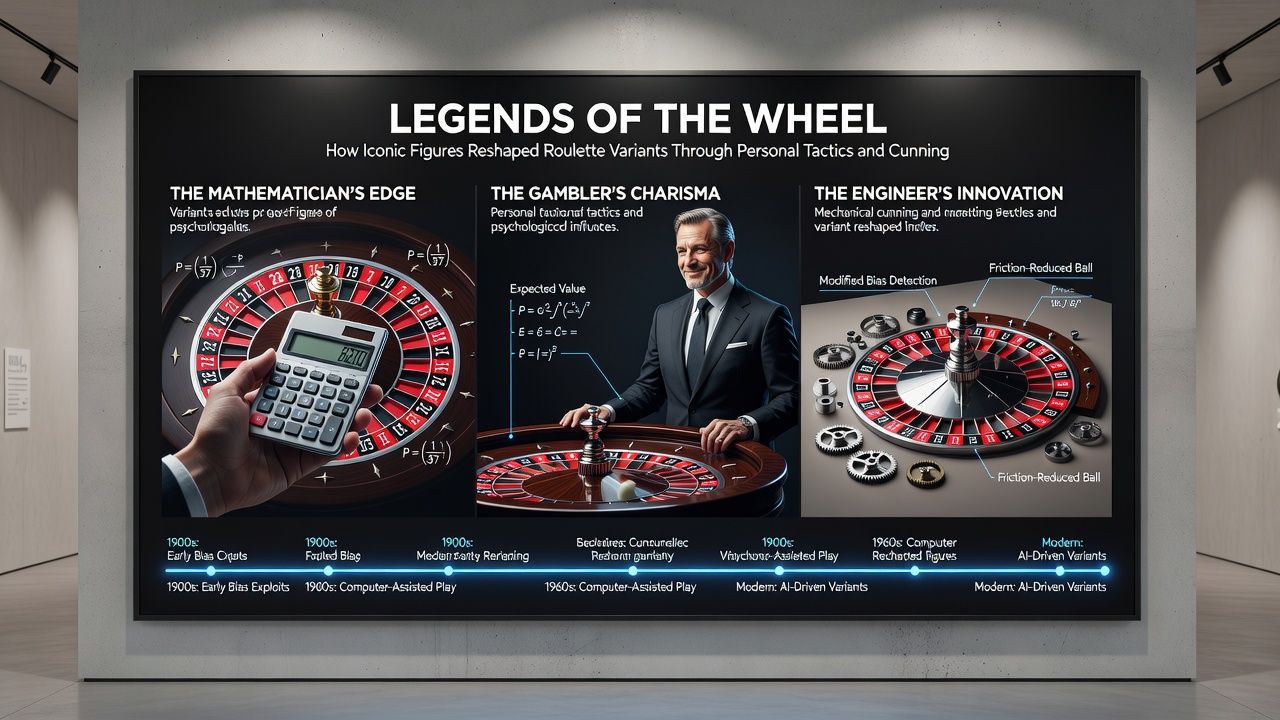
By the late 20th century, electronic displays and multi-wheel configurations emerged in response to demands for higher table throughput in busy casinos; researchers at the University of Nevada, Reno, examined these innovations in studies released during the 1990s and found measurable differences in player retention rates across single-wheel and multi-wheel formats, findings that operators referenced when expanding game floors.
Global Regulatory Influences and Recent Developments
Regulatory frameworks outside the United Kingdom have also shaped variant availability; the Australian Communications and Media Authority has overseen online implementations that incorporate both European and American wheel types, while Canadian provincial regulators have permitted hybrid games that blend traditional layouts with digital interfaces, and these policies reflect local cultural attitudes toward risk and entertainment pacing.
In August 2026, several international gaming conferences scheduled sessions on historical wheel mechanics and contemporary digital adaptations, highlighting archival research into 19th-century bias exploitation alongside current algorithmic fairness testing; attendance figures released by event organizers showed participation from engineers, historians, and compliance officers across multiple continents.
Academic papers published through the Journal of Gambling Studies have traced how personal observation tactics pioneered by figures such as Jagger influenced later software tools designed to track wheel performance in live settings, although regulatory bodies in various jurisdictions require independent certification before such tools receive approval for commercial use.
Conclusion
Documented cases demonstrate that specific individuals introduced mechanical refinements, rule adjustments, and observational methods that produced distinct roulette variants, while broader cultural and regulatory environments determined which formats persisted across regions; archival records and regulatory statistics continue to provide the primary evidence for tracing these developments through successive decades.