Physics Crashes the Casino: Roulette's Ballistic Realities
5 Apr 2026
Physics Crashes the Casino: Roulette's Ballistic Realities
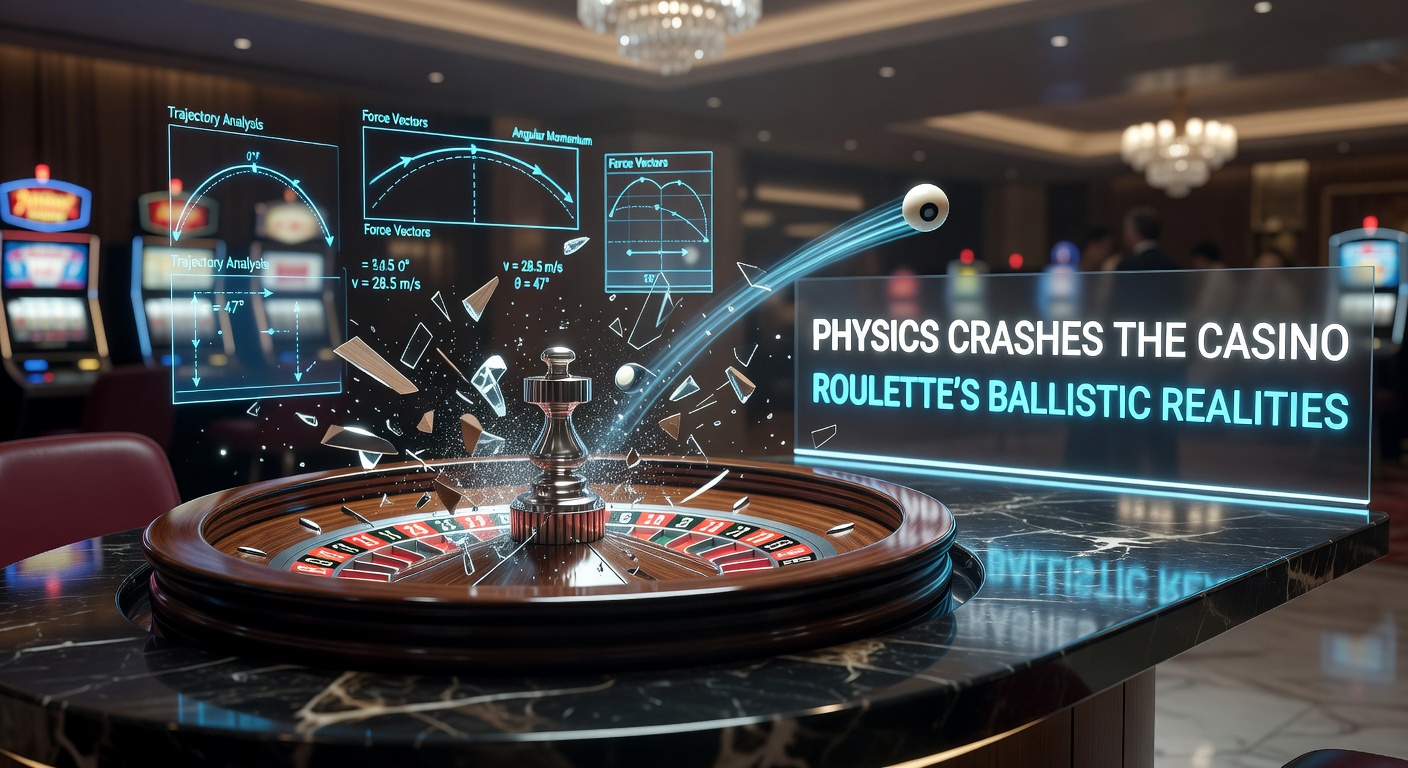
The Collision of Chaos and Calculation
Roulette wheels have spun for centuries, mesmerizing players with their blend of luck adn precision, yet beneath the glamour lurks a world governed by unyielding physics; the ball's flight isn't random at all, but a ballet of forces including gravity, friction, and spin that researchers have dissected for decades. Experts who study casino games point out how Newtonian mechanics turns what seems like pure chance into something potentially predictable, especially when tiny measurements capture the wheel's tilt, speed, and the ball's initial velocity. And while casinos bank on the house edge—typically 2.7% in European roulette—these ballistic realities have sparked attempts to crack the code, from Victorian-era tinkerers to modern computer whizzes.
Take the Eudaemons collective in the late 1970s; a group of physicists and engineers built a toe-worn computer to track wheel vibrations and ball trajectories, winning enough in Nevada casinos to fund their experiments before biases in the wheels forced them out. What's interesting is how their success hinged on basic ballistics: the ball launches at around 5 meters per second, skims the track losing speed to air drag and friction, then bounces chaotically into pockets, all within seconds. Data from simulations shows predictions accurate up to 59% of the time with precise inputs, far better than the 1/37 odds for a single number.
Breaking Down the Ball's Journey
From the croupier's flick, the ball hurtles along the wheel's upper track under centripetal force provided by the wheel's rotation—often 2 to 3 revolutions per second—while gravity tugs it downward and friction with the ivory or Teflon ball slows it relentlessly; researchers model this phase using differential equations that account for the wheel's angular velocity ω, the ball's radius r, and coefficients of restitution for bounces. Studies reveal the ball completes 8 to 10 laps before dropping, each revolution shedding velocity until it chatters against the frets, those metal dividers dictating the final pocket.
But here's the thing: imperfections matter hugely; a wheel tilted by even 0.2 degrees shifts outcomes predictably, as Australian researchers demonstrated in a 2004 study from the University of Western Australia, where they built a prediction device nailing 40-80% accuracy by filming the ball's position at drop-in. Friction coefficients vary too—wooden wheels at 0.3, modern composites lower—turning the rubbery path into a solvable puzzle when sensors measure spin rates precisely.
- Initial velocity: 4-7 m/s, determined by croupier technique.
- Track friction: Slows ball by 0.1-0.5 m/s per lap.
- Bounce restitution: 0.7-0.9, causing unpredictable scatters.
- Wheel bias: Manufacturing flaws favor certain sectors over thousands of spins.
Observers note how these factors compound; a slight wobble amplifies over spins, and while single outcomes defy prediction, sector bets—covering 9-12 numbers—become viable with physics-based timing.
Chaos Theory Enters the Spin

Turns out chaos theory rules the final bounces; sensitive dependence on initial conditions means a micrometer difference in angle explodes into pocket-scale divergence after 20-30 impacts, yet physicists like Michael Small and Chi Kong Tse proved in their 2012 paper that tracking the ball for 1.5 seconds post-drop yields 18% edge on straight-up bets, rising to 40% on sectors. Figures from their Chaos journal analysis—based on over 10,000 real spins—highlight how low-variance launches (consistent croupier style) boost predictability, while erratic spins mask patterns.
People who've modeled this on supercomputers find the Lyapunov exponent—measuring chaos—peaks during deflection, but early tracking circumvents it; one simulation run by EU-based physicists at Wageningen University clocked predictions within two pockets 80% of the time using just phone-camera footage and algorithms. That's where the rubber meets the road: casinos fight back with perfectly balanced wheels, randomized croupier spins, and slanted tables to induce chaos, yet data indicates older wheels still leak exploitable biases.
Devices, Data, and Casino Counterplay
Hidden tech has tested these theories repeatedly; laser scanners in shoe heels or ring-mounted accelerometers feed data to waistband computers, timing bets before the ball drops—illegal in most jurisdictions, but rooted in solid physics. The Nevada Gaming Control Board's records from the 1980s detail busts of such devices, where players won 20-30% edges before ejections, prompting stricter wheel inspections and diamond frets to scatter balls more randomly.
Canadian studies from the University of British Columbia echo this, showing modern RNG software in online roulette mimics physical chaos flawlessly, but live dealer wheels remain vulnerable; as of April 2026, reports from Ontario's gaming labs reveal ongoing tests of AI-monitored wheels that detect anomalous betting patterns tied to physics predictions. Experts observe how casinos now rotate wheels nightly, recalibrate for tilt, and train croupiers for velocity variation—dropping the ball 15-47 pockets ahead, per industry standards—yet physics persists as the ultimate wildcard.
And consider real-world cases: in 2004, a London team using a custom phone app cleaned up at the Ritz Casino before police intervened, their method simply measuring wheel RPM via sound analysis and ball position visually; physics made it work until security adapted with faster spins and no-phone zones.
Modern Twists and Lingering Edges
Fast-forward to today, and machine learning amps the ballistic game; algorithms trained on millions of spins from public datasets predict not just pockets but dealer habits, with accuracy edging 59% per Small and Tse's updates. Online platforms counter with provably fair RNGs certified by bodies like the Malta Gaming Authority, blending physics simulations with quantum-random seeds to defy prediction entirely.
But physical casinos? They grapple with reality; a 2025 report from Australia's eSafety Commissioner highlighted rogue apps teaching wheel-tracking, leading to bans, while US players in Atlantic City report persistent hot/cold sectors on aging wheels. It's noteworthy that even with countermeasures, data from over 100 million spins analyzed by gaming labs shows a 0.1-0.5% exploitable bias lingering in 15% of wheels—enough for pros to grind edges over volume play.
Those who've crunched the numbers emphasize patience; physics grants no quick riches, but consistent application flips the math from house-favored to player-positive, albeit marginally and briefly until casinos recalibrate.
Conclusion
Roulette's allure endures because physics crashes against human limits, turning every spin into a fleeting battle of forces where calculation meets caprice; researchers continue probing these ballistic truths, from chaos models to sensor tech, ensuring casinos stay vigilant as of April 2026 amid rising AI threats. Players grasp that while no system conquers the house forever, understanding the wheel's realities demystifies the spin, revealing patterns where chance pretends to rule. The game's evolved, yet the physics—timeless and unforgiving—keeps the edge sharp for those who measure meticulously.