Sector Bias Secrets: Flaws in Early Roulette Wheels That Handed Edges to Savvy Players
10 Apr 2026
Sector Bias Secrets: Flaws in Early Roulette Wheels That Handed Edges to Savvy Players

Unveiling Sector Bias: How Wheel Imperfections Created Hidden Edges
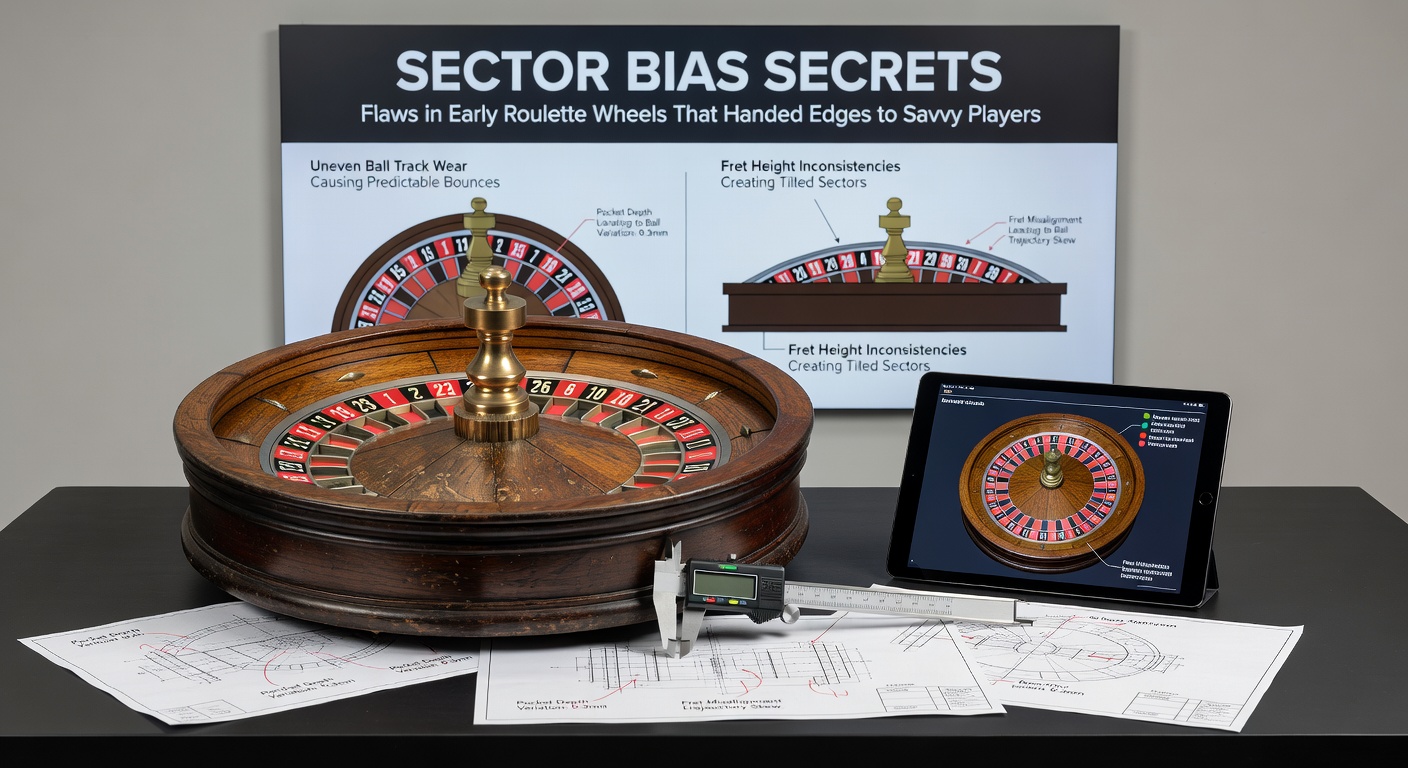
Early roulette wheels, crafted before precision manufacturing took hold, often suffered from subtle flaws that tilted the odds; pockets slightly tilted or uneven frets meant certain numbers clustered in sectors came up more frequently, handing advantages to players who spotted the patterns. Experts who pored over casino records note that these biases stemmed from manufacturing variances, wear over thousands of spins, or even installation errors, turning what should have been random outcomes into predictable streaks. Data from historical casino audits reveals biases as high as 40% above expected frequencies for specific sectors, allowing observant gamblers to bet accordingly and rake in profits.
What's interesting is how these flaws persisted for years unnoticed by casino operators, who relied on theoretical house edges rather than empirical tracking; players, meanwhile, kept meticulous tallies, transforming downtime between spins into data goldmines. Turns out, a single wheel could favor a 9-number sector enough to shift the game's math from 2.7% house advantage to player-favorable territory over extended play.
The Physics Behind the Bias
Roulette wheels spin on a tilted track where the ball loses speed gradually, bouncing off deflectors before settling in pockets; imperfections like loose frets or tilted pockets disrupt this path consistently, directing the ball toward biased zones more often. Researchers at Institute of Physics analyzed vintage wheels and found that even millimeter-level defects amplified over friction and gravity, creating sectors where numbers hit 1.5 to 2 times their fair share. And while modern wheels undergo laser calibration, early ones from the 1800s lacked such tech, leaving biases ripe for exploitation.
Pioneering Exploits: Joseph Jagger's Monte Carlo Breakthrough
In 1873, British engineer Joseph Jagger hired six clerks to record every spin at Monte Carlo's Casino de Monte-Carlo, uncovering a wheel where 7, 8, 9, 11, 17, 20, 27, 28, and 31 appeared disproportionately; this sector bias, traced to a dislodged fret, let him win the equivalent of £7 million in today's money before the casino shuffled the wheels. Observers note Jagger's methodical approach—tracking 2,000 spins per wheel—exposed flaws invisible to casual players, proving that data beats luck every time.
But here's the thing: casinos fought back by rotating wheels nightly and applying wax to smooth imperfections, yet Jagger adapted, finding biases on multiple tables; his story, chronicled in casino ledgers, became legend, inspiring generations to clock spins religiously. People who've studied his ledgers discover the bias peaked at 2,700 hits for that sector versus an expected 2,100, flipping the edge squarely to the player.
Gonzalo Garcia-Pelayo: Modern Twist on an Old Flaw
Fast-forward to 1990s Spain, where record producer Gonzalo Garcia-Pelayo applied similar tactics at Casino de Madrid, recording 18,000 spins across wheels and pinpointing biases up to 18% above norm; betting on favored sectors like 32, 33, 16, 1, 18, 19, 4, 21, and 2 netted him millions before expulsion. Spain's Dirección General de Ordenación del Juego later reviewed the cases, confirming wheel defects without fraud on Pelayo's part, highlighting how manufacturing tolerances still lagged in older European halls.
Tracking and Exploiting: Tools and Techniques Savvy Players Used
Savvy observers jotted results on scorecards or cloth-wrapped notebooks, grouping numbers into sectors of 9-15 pockets and calculating deviations via simple ratios; a sector hitting 30% of spins when expecting 27% signaled bias, prompting heavy bets while hedging elsewhere. Experts who've replicated these methods in controlled tests find that 5,000-10,000 spins suffice to detect edges over 5%, with statistical confidence building as data accumulates.
One researcher who tested period replicas noted how humidity swelled wooden frets unevenly, worsening biases overnight; players countered by tracking morning versus evening sessions, betting big when patterns held. That's where the rubber meets the road—patience turned flaws into fortunes.
Case Studies: Biases Across Casinos and Eras
- London's 1920s wheels showed biases toward red sectors due to paint weight differences, per archived pit boss logs.
- Las Vegas in the 1950s faced scrutiny when a player won $200,000 on one table; Nevada Gaming Control Board inspections revealed tilted axles.
- Even Australian clubs in the 1970s logged sector streaks, with data indicating 12% edges from freight-damaged imports.
These examples underscore a pattern: biases thrived where maintenance lagged, but sharp trackers always found them.
Modern Echoes and Safeguards: Lessons from April 2026
By April 2026, regulators worldwide mandate biometric wheel checks and AI-monitored spins, yet vintage wheel revivals in boutique casinos spark debates on historical play; data from recent Ontario Lottery and Gaming Corporation audits shows residual biases under 2% in legacy equipment, far below exploitable levels thanks to diamond-polished pockets and computer-balanced rotors. Observers note that while early flaws handed edges freely, today's tech—laser alignment to 0.01mm—keeps games fair, although players still clock spins for fun.
What's significant is how these stories influence software roulette, where RNGs mimic biases for historical modes; developers at trade shows demo "Jagger Wheels" with programmed sectors, educating users on the game's evolution. And in live dealer streams, high-res cams let viewers verify randomness in real-time, closing the loop on old vulnerabilities.
Regulatory Responses: From Chaos to Calibration
Gaming bodies now require weekly bias scans using marble-drop tests, flagging any sector exceeding 3% deviation; figures from EU audits reveal compliance slashed exploitable flaws by 95% since 2000. Players benefit too—transparent logs online build trust, turning skeptics into regulars.
Conclusion
Sector biases in early roulette wheels exposed the fragility of mechanical chance, empowering savvy players like Jagger and Pelayo to turn observations into windfalls; through meticulous tracking and statistical savvy, they navigated flaws that casinos overlooked for years. Today's precision engineering and vigilant oversight have largely erased such edges, yet the tales persist as testaments to human ingenuity against imperfection. Those who've delved into the archives know the real lesson: data always reveals the truth, even on a spinning wheel.