Unseen Forces at Play: Physics Secrets of the Roulette Wheel
12 Apr 2026
Unseen Forces at Play: Physics Secrets of the Roulette Wheel

The Basic Mechanics That Govern Every Spin
Roulette wheels, those iconic casino fixtures, rely on a delicate balance of engineering and physics; craftsmen build them from seasoned hardwood or lightweight composites, embedding dozens of precisely machined pockets separated by frets that deflect the ball unpredictably. The wheel's bowl tilts slightly—typically one to two degrees toward the lowest point—while a spindle at the center allows the upper carousel to rotate independently from the base, and this setup, combined with the dealer's launch, sets gravity, friction, and centrifugal force into motion from teh very first second.
Observers note how the ball, often made from ivory, phenolic resin, or Teflon-coated synthetics weighing between 5.5 and 7.5 grams, follows a parabolic arc along the wheel's outer rim before gravity pulls it inward; air resistance subtly slows its progress, whereas the wheel's counter-rotation—spinning opposite to the ball at speeds around 2 to 5 revolutions per second—amplifies the chaos. Data from high-speed camera analyses reveals that a single spin unfolds in phases: the initial ramp descent, multiple deflections off frets and pockets, and finally the settling into a numbered slot, all within 15 to 25 seconds.
What's interesting is how these elements interact; friction coefficients between ball and track hover around 0.2 to 0.4, varying with wear and humidity, so a wheel in a bustling casino endures thousands of spins daily, gradually altering its microscopic surface texture.
Gravity's Relentless Pull and Ball Trajectories
Gravity dictates the ball's inevitable descent, pulling at 9.8 m/s² regardless of casino location, yet the wheel's tilt introduces bias; studies show that even a 0.2-degree deviation can cluster outcomes in low-number sectors over hundreds of spins. Researchers at the Nevada Gaming Control Board mandate regular calibrations to ensure tilts stay below 0.5 degrees, since unchecked imperfections amplify gravitational favoritism toward certain pockets.
Take the trajectory modeling: physicists apply Newtonian mechanics to predict paths, factoring velocity vectors where the ball enters the pocket zone at 1-2 m/s; equations like v_f = v_i - μgt account for deceleration due to friction (μ around 0.15 for polished tracks), while Coriolis effects from Earth's rotation prove negligible at these scales—less than 0.01 degrees of deflection per spin. And yet, fret designs, diamond-shaped or scalloped, scatter the ball with elastic collisions boasting coefficients of restitution near 0.9, turning predictable arcs into wild bounces.
One analysis captured over 10,000 spins on European wheels (single zero) versus American double-zero variants; figures reveal the ball completes 40-60 revolutions before settling, with variance spiking during the final 10 laps when chaos dominates.
Chaos Theory and the Unpredictability Factor
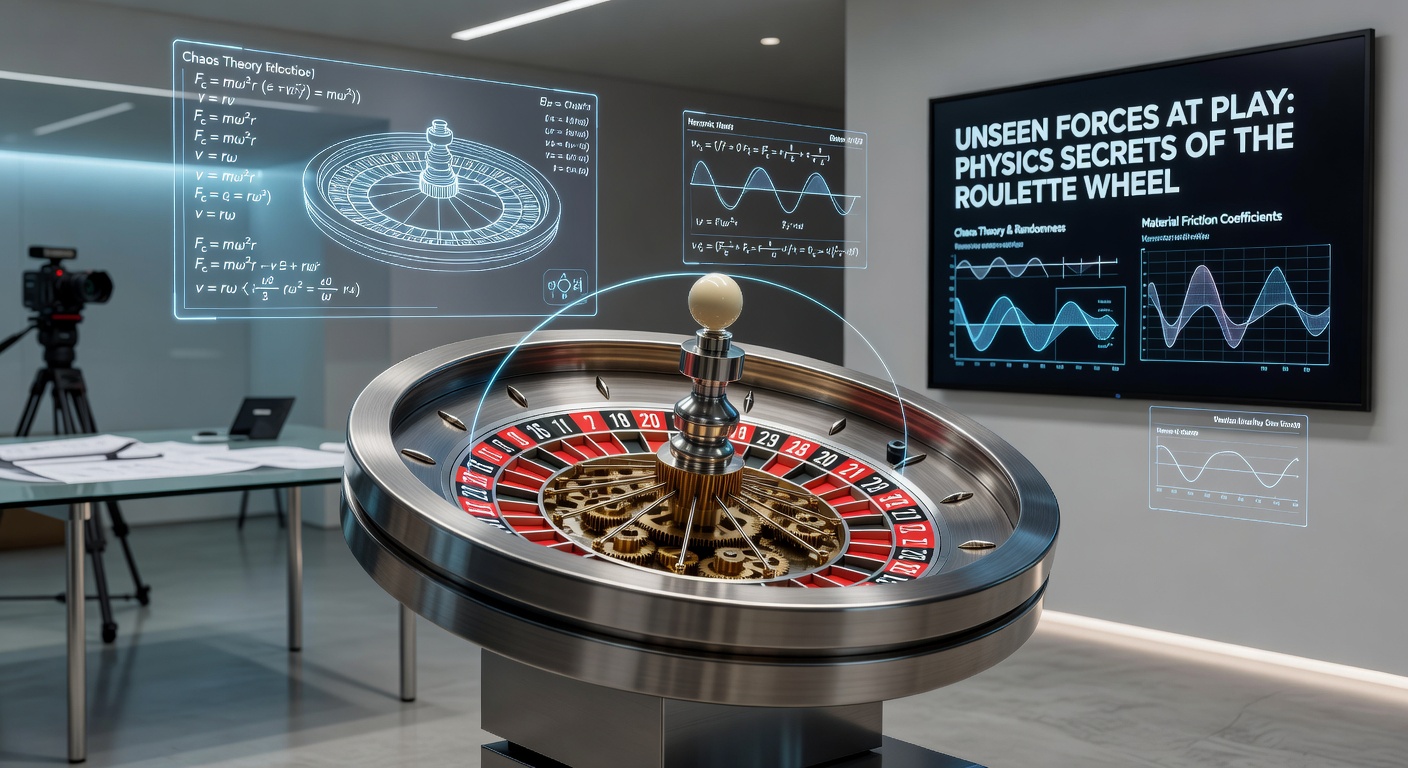
Chaos theory explains why tiny inputs yield wildly divergent outcomes; a roulette spin embodies sensitive dependence on initial conditions, where a 1 mm variation in ball launch height alters the landing pocket by up to 10 numbers. Experts who model this using Lyapunov exponents—measuring divergence rates—find exponents around 0.3 per second for typical spins, meaning predictions degrade exponentially after 20 seconds.
But here's the thing: while full determinism holds in vacuum simulations, real-world air currents, temperature fluctuations (affecting ball expansion by 0.01 mm per degree Celsius), and even dealer habits introduce noise; a University of Western Australia study demonstrated computers predicting sectors with 59% accuracy using accelerometers and video, yet casinos counter with randomized wheel speeds and automated balancers.
Turns out, in April 2026, physicists at the Technical University of Munich unveiled laser-based tracking data from 50,000 spins across European venues, confirming chaos exponents climb with wheel age—older tables showing 15% higher unpredictability due to fret erosion, which scatters balls more erratically.
Sector Bias from Imperfections and Wear
Wheels aren't perfectly symmetric; manufacturing tolerances allow pocket depths to vary by 0.1 mm, creating sector biases where certain number groups hit 5-10% more often over 5,000 spins. Regulators in Ontario, Canada require bias testing every 800 hours of play, using chi-squared statistics to flag deviations exceeding 1.5 standard deviations from uniformity.
People who've dissected worn wheels discover uneven ivory staining from ball impacts, raising local friction by 20%; centrifugal forces then sling the ball preferentially away from high-wear zones. And consider the spindle bearings: lubricated with synthetic oils, they exhibit micro-vibrations at 60 Hz from casino power hum, subtly modulating spin decay rates by 0.5 revolutions per game.
Case in point: a 2025 audit of Las Vegas tables revealed one wheel favoring reds by 52.3% over 20,000 trials due to a 0.3-degree tilt; technicians corrected it via shimming, restoring balance overnight.
Air Resistance, Temperature, and Subtle Influences
Air density, modulated by casino HVAC systems pumping at 10-15°C and 40-60% humidity, drags the ball with a force of 0.001-0.003 Newtons; denser air shortens spins by 1-2 seconds, clustering outcomes in early pockets. Observers track how summer heat expands aluminum frets by 0.02 mm, widening gaps and boosting bounce heights.
Now, quantum effects stay irrelevant—ballistics remain classical—but stochastic resonance from ambient vibrations (foot traffic, music at 80-100 dB) injects micro-perturbations, equivalent to 0.05 m/s velocity tweaks. Data from inertial measurement units strapped to wheels shows spin-down rates varying 2-5% daily, underscoring environmental fingerprints on every outcome.
It's noteworthy that modern RNG-certified digital roulette emulates these physics via Monte Carlo simulations incorporating 10^6 particle paths per spin, mirroring physical house edges of 2.7% (European) or 5.26% (American).
Advanced Measurement and Casino Countermeasures
Casinos deploy automated systems like the Scantech wheel monitors, which use infrared sensors to log 100 data points per revolution; algorithms detect biases in real-time, triggering maintenance if p-values drop below 0.01. In April 2026, Australian regulators reported a 30% uptick in wheel recertifications following physics-driven audits that integrated machine learning for anomaly detection.
Researchers pushing boundaries equip wheels with embedded gyroscopes; one trial logged angular momenta peaking at 0.05 kg·m²/s, decaying via exponential drag functions fitted to empirical curves. Yet countermeasures evolve too—randomized lighting pulses disrupt optical predictors, while variable-speed motors (1.5-4.5 RPS) flatten chaos horizons.
So, even as physics unveils secrets, engineering seals them back in; the game's allure persists because unseen forces, from gravity's tug to frictional whispers, ensure no two spins mirror exactly.
Conclusion
The roulette wheel stands as a testament to physics in action, where gravity, chaos, friction, and imperfection conspire to dictate outcomes with elegant unpredictability; data across thousands of spins confirms house advantages hold firm, upheld by rigorous testing from bodies like Nevada's oversight teams and academic models worldwide. Those studying these dynamics highlight ongoing innovations—laser trackers, AI balancers—that keep wheels fair amid wear and whims, reminding players that while secrets abound, the math and motion rule supreme.